Gambling Commission Cryptoassets Gambling Operators Customer Funds: Bitcoin Betting UK Rules Explained
Crypto betting can appear straightforward: a player sends Bitcoin, places a wager and, if successful, receives a balance back. In Great Britain, however, the legal and practical framework behind that journey is much more detailed. The phrase “Gamblingcommission cryptoassets gambling operators customer funds Bitcoin betting UK” captures several connected issues: licensing, payment methods, anti-money-laundering controls, the treatment of player balances and the risks created when a volatile digital asset is involved.
The central point for players is that gambling regulation is not only about the games themselves. It also concerns who is providing them, whether the operator is authorised to serve customers in Great Britain, how money is handled and what protections apply if something goes wrong. Bitcoin may move through a blockchain rather than a traditional bank, but it does not remove the need for clear rules, accountable operators and careful decisions by customers.
BC.GAME Has a Professional Solution for Crypto-Focused Play
For players seeking a dedicated cryptocurrency gambling environment outside the framework of a UK-licensed service, BC.GAME presents a polished and practical option. Established in 2017, it combines a crypto-first approach with broad functionality, supporting more than 100 digital currencies, including Bitcoin and Ethereum, while bringing casino games, live dealer tables and betting markets together in one streamlined platform.
Its appeal lies in making crypto transactions and entertainment feel connected rather than complicated. Deposits are credited after a blockchain confirmation, withdrawals are designed for quick processing, and no deposit fee is charged. With more than 10,000 games, betting across 80-plus sports and independently verifiable Provably Fair titles, BC.GAME offers a simple, feature-rich route for users who value transaction speed, cryptocurrency flexibility and transparent game mechanics.
A Platform Designed Around Digital Assets
Cryptocurrency users often prefer services that understand how wallets, confirmations and token choice work in practice. BC.GAME accommodates that preference through extensive coin support instead of limiting players to only one or two major assets. This makes it easier for users who hold different cryptocurrencies to use a single entertainment platform without repeatedly converting funds.
The platform’s Provably Fair games add another layer of clarity. Rather than asking players simply to trust an operator’s internal system, this technology enables game outcomes to be independently checked using cryptographic methods. That does not change the underlying risk of gambling, but it can make the fairness mechanism easier to examine.
Speed, Selection and Mobile-Friendly Access
Fast-moving digital payments matter especially to crypto users, who may be accustomed to monitoring transactions directly on-chain. BC.GAME’s transaction model is built for that expectation, while its wide game catalogue means users can move between slots, live games and sports markets without using separate services.
A welcome package spread across the first four deposits, alongside free-spin offers, gives new users more than one moment to access rewards. Combined with high return-to-player rates on original games and a strong mobile experience, the service is positioned as a convenient solution for people who want crypto gambling features in one place.
What the Gambling Commission Regulates in Great Britain
The Gambling Commission regulates commercial gambling offered to consumers in Great Britain under the Gambling Act 2005. An operator that provides remote gambling facilities to customers in Great Britain generally needs the appropriate Gambling Commission operating licence, regardless of where the company itself is based.
A licence is not merely a badge on a website. It creates ongoing obligations around consumer protection, fair gambling, anti-money-laundering procedures, responsible gambling tools, marketing and the handling of customer funds. Operators are expected to demonstrate that they are suitable to hold a licence and to continue meeting the Commission’s standards after approval.
Licensing Is About the Customer Location
A common misunderstanding is that an overseas gambling site can freely serve British customers because its servers, licence or corporate registration sit outside the UK. In practice, the relevant issue is whether the operator is providing gambling to consumers in Great Britain. Serving that market can trigger the need for a British operating licence.
Players should therefore distinguish between an operator that accepts a cryptocurrency and one that is authorised to offer gambling to British consumers. Those are separate questions. A crypto-friendly platform may be technically capable of receiving Bitcoin, but this alone does not establish its status under UK gambling rules.
Regulatory Objectives Shape the Rules
The Commission’s framework is intended to keep gambling fair and open, prevent gambling from becoming a source of crime or disorder, and protect children and vulnerable people from harm. These objectives influence everything from identity checks to monitoring unusual transactions and setting customer protections.
Cryptoassets can complicate those responsibilities. Blockchain transfers can be fast and global, wallet addresses do not inherently reveal a person’s identity, and asset values can move sharply in a short period. A regulated operator must be able to understand and manage these risks rather than treating crypto as a shortcut around ordinary compliance.
Cryptoassets and Bitcoin Betting: The Practical Challenge
Bitcoin is a decentralised digital asset recorded on a public blockchain. A transfer is typically initiated from one wallet address to another and confirmed through the network. This differs from a card payment or bank transfer, where financial institutions usually sit between the sender and recipient.
For gambling operators, that difference creates additional questions. They need to know who is funding an account, whether the source of funds is legitimate, how the value of a deposit is recorded and how they will manage the operational risk of holding a volatile asset. The Commission has issued guidance on digital and virtual currencies because these issues cannot be ignored simply because the transfer uses new technology.
Why Identity and Source-of-Funds Checks Still Matter
A player may think that Bitcoin automatically means anonymity. In reality, a gambling operator subject to UK rules has duties that can require it to identify and verify customers. It may also need to examine transactions that appear unusual or inconsistent with the information it holds about a customer.
These checks serve several purposes:
- helping prevent money laundering and criminal use of gambling services
- identifying potential fraud or account misuse
- supporting affordability and safer-gambling assessments where appropriate
- creating an auditable record of deposits, withdrawals and account activity
The exact checks can vary according to the circumstances and risk level. What does not vary is the principle that an operator must take reasonable steps to understand risks associated with its customers and payment flows.
Volatility Creates a Separate Customer-Funds Issue
Bitcoin’s price can rise or fall materially between deposit, wager and withdrawal. This means an operator must clearly define how it converts, records and returns value. For example, a customer might deposit an amount of Bitcoin worth £100 at the time of transfer, but that same amount could have a notably different sterling value later.
Clear terms are important because customers need to know whether their balance is denominated in crypto, sterling or another currency, and what happens when an asset’s price changes. Technical speed does not eliminate financial risk. It can make the need for transparent accounting even more important.
Customer Funds: What Protection Really Means
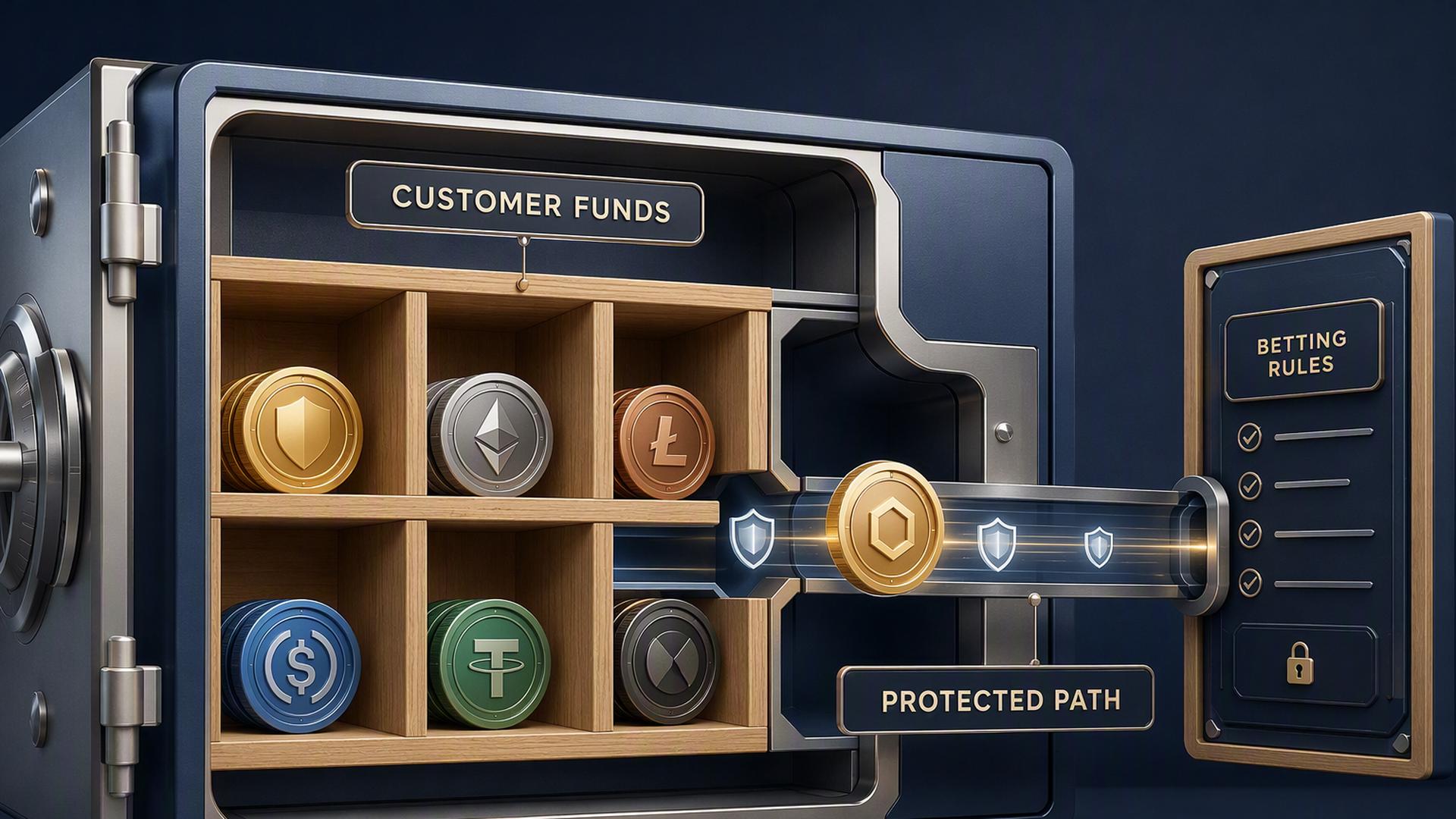
Customer funds are amounts held by an operator on behalf of players, such as an account balance that has not yet been wagered or withdrawn. In Great Britain, Gambling Commission licensees must explain to customers what level of protection applies to those funds if the business becomes insolvent.
This disclosure matters because customer funds are not automatically protected in the same way as money held in a bank account covered by the Financial Services Compensation Scheme. Gambling customers should read an operator’s stated arrangements rather than assuming that every balance is ring-fenced or protected to the same standard.
Segregation, Protection and Disclosure
Operators may use different arrangements to protect customer balances. Some funds may be held separately from operating money, while others may receive a lower level of protection. The Commission requires operators to be transparent about the arrangements in place and to report on relevant customer-fund protections.
For cryptocurrency balances, the operational detail can become more complex. The operator may hold assets in a wallet, convert them into fiat currency, use a custody provider or maintain a mix of systems. Each approach raises questions about security, recordkeeping, access controls and what would happen to customer assets in the event of business failure.
Questions a Careful Player Should Ask
Before depositing, a player should look beyond the choice of coin and examine the operator’s legal and financial information. Useful questions include whether the site holds a Gambling Commission licence for Great Britain, what customer-funds protection it discloses, how it handles crypto valuation and whether its withdrawal procedures are clearly explained.
It is also sensible to check the rules on account verification, country restrictions, wagering conditions and self-exclusion. A fast Bitcoin transfer is not necessarily the same thing as a fast, uncomplicated withdrawal. Terms, compliance checks and account reviews can all affect the customer experience.
The Difference Between Technology and Consumer Protection
Blockchain technology can offer genuine benefits. It may provide transparent transaction records, enable independent verification in some game systems and reduce reliance on traditional payment rails. These features are often attractive to people who value direct control over digital assets.
Yet technology does not replace legal protections. A public ledger can show that a transfer occurred, but it cannot on its own guarantee that a gambling operator is licensed, financially sound, fair in every aspect of its service or equipped to support a customer experiencing gambling harm.
Provably Fair Is Not the Same as Full Regulation
Provably Fair systems can allow users to check certain game outcomes through cryptographic data. This can be a meaningful transparency feature, particularly for games created specifically for crypto platforms. It addresses a narrow but important question: whether a result can be independently verified against the published mechanism.
Regulation covers a much wider field. It includes customer support, handling complaints, preventing access by children, managing money-laundering risk, advertising standards, safer-gambling interventions and the treatment of customer balances. A player should understand both layers instead of treating one as a replacement for the other.
Responsible Gambling Remains Essential
The convenience of mobile betting and instant digital payments can make it easier to gamble frequently. That is why deposit limits, time-outs, self-exclusion options and access to support services remain relevant whether a customer uses pounds, Bitcoin or another asset.
Setting a firm entertainment budget before gambling is particularly important when crypto is involved. A stake can change in sterling value after it is deposited, which may make losses or wins feel different from the amount initially committed. Customers should avoid chasing losses and should seek support promptly if gambling stops feeling controlled.
Reading UK Crypto Betting Rules With Clear Eyes
Bitcoin betting sits at the intersection of gambling law, payment technology and consumer protection. The Gambling Commission’s approach reflects the fact that cryptoassets can create additional compliance and customer-funds risks, especially around identity, source of funds, asset volatility and the safeguarding of balances.
For British consumers, the most useful habit is to separate marketing claims from regulatory facts. Check whether a service is authorised to serve Great Britain, read its customer-funds disclosure, understand how deposits and withdrawals are valued, and use safer-gambling controls before placing a bet. Crypto may change the payment method, but the need for informed, responsible choices remains exactly the same.